Checking an AI answer can turn into another substantial piece of work. Someone has to read the sources, compare them with the answer and decide whether the model has carried the meaning through. A cheaper way to help with that work would give people a reason to check more often, including when an answer looks ordinary enough to pass without much attention.
That is where Jev caught my attention. TypeSafe AI introduced the model last week, and on Sunday announced that it was opening access without a waitlist. By Monday, Simon Willison was describing his experiments with it and several projects other developers had shared. There is something useful underneath the early enthusiasm: a model built to make small judgments at a very low price.
An answer software can use
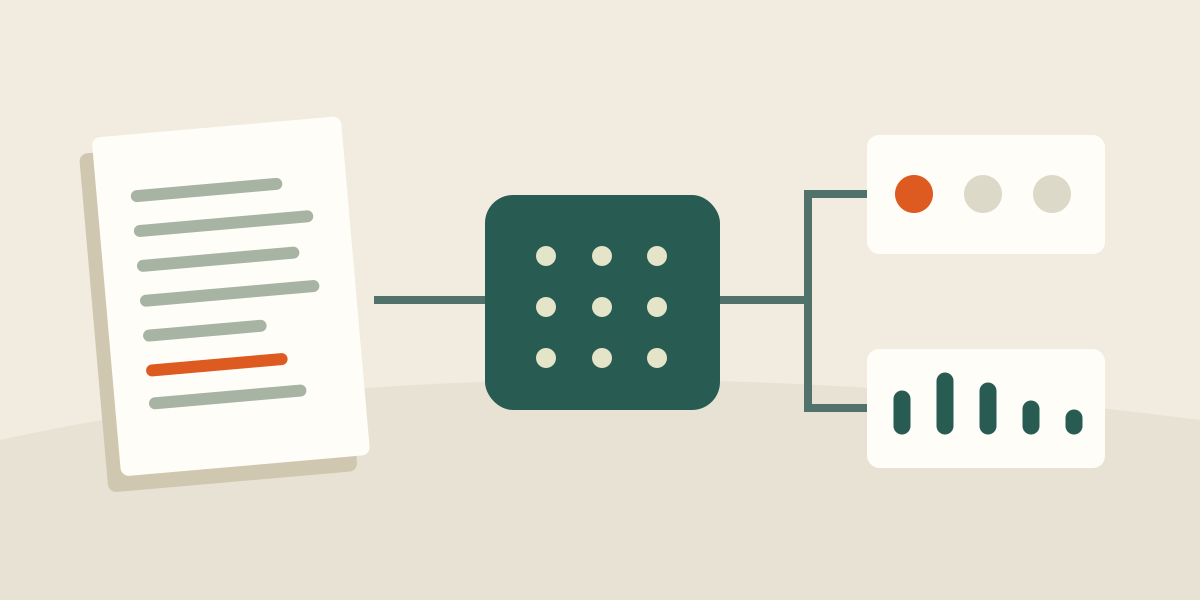
Give Jev some text and a question, and it can choose from options you supply or return a score. TypeSafe calls these System One models. The documentation describes narrow questions with structured answers, including probability distributions. A program can use those results to sort items or decide which ones need attention.
For example, a support team could ask which category a message belongs in. Someone searching a large document collection could score how well each candidate matches the question. Willison has been experimenting with that second use. The person asking for help still receives an ordinary answer; a scoring model helps select the material used to prepare it.
The format also fits evaluation. A model could read a draft alongside its source and rate whether a particular claim is supported. If the task calls for several checks, TypeSafe says its parallel question format can handle them in one request, with little extra response time. That is a useful design for work that would otherwise require repeated exchanges.
The price changes what is worth trying
TypeSafe's launch price is $0.042 per million input tokens, with no output charge. Tokens are the pieces of text a model processes. At that rate, a hypothetical set of 1,000 checks using 5,000 input tokens each would cost about 21 cents in model input charges.
Illustrative input cost
That calculation covers the stated model input price. Preparing source material, defining a useful question and reviewing the result still take work. It also assumes each request fits within the model's limits. Even with those qualifications, the charge for trying a substantial batch of narrow checks is small enough to encourage experimentation.
For work like ours, I can see trying a model at this price to score more candidate answers and compare how well they address a question. The cost also leaves room to repeat an evaluation after a draft changes. Those are possibilities we would need to test, but the model charge gives us little reason to limit a useful experiment to a handful of examples.
Accuracy still has to be measured
TypeSafe makes strong claims about speed and cost. Its published workflow evaluations compare results with reference answers generated by other large models. That is evidence about agreement on those tasks. It leaves the practical question of how well Jev would catch errors in the particular material someone wants to review.
The evaluator needs to find enough real problems to justify the time spent following its flags. A successful trial would give a team a reason to review more of its AI work, with attention directed toward passages likely to need a correction.
I would start with a small collection of source documents and summaries whose problems are already understood, then see what Jev finds and what it misses. The input price makes that experiment easy to justify. Its results would tell us whether to give it more work.