Why I am watching this now
We are entering a phase where people ask language models questions they used to spread across search, maps, reviews, and friends. Some of those questions are intensely personal. Others are practical local intent: "Who is a reliable plumber near me?" or "Where should I eat tonight?"
If paid placement enters that experience without strong trust guardrails, bad recommendations are only the most visible layer of harm. The deeper risk is trust collapse in the interface people are beginning to treat as a "trusted Google."
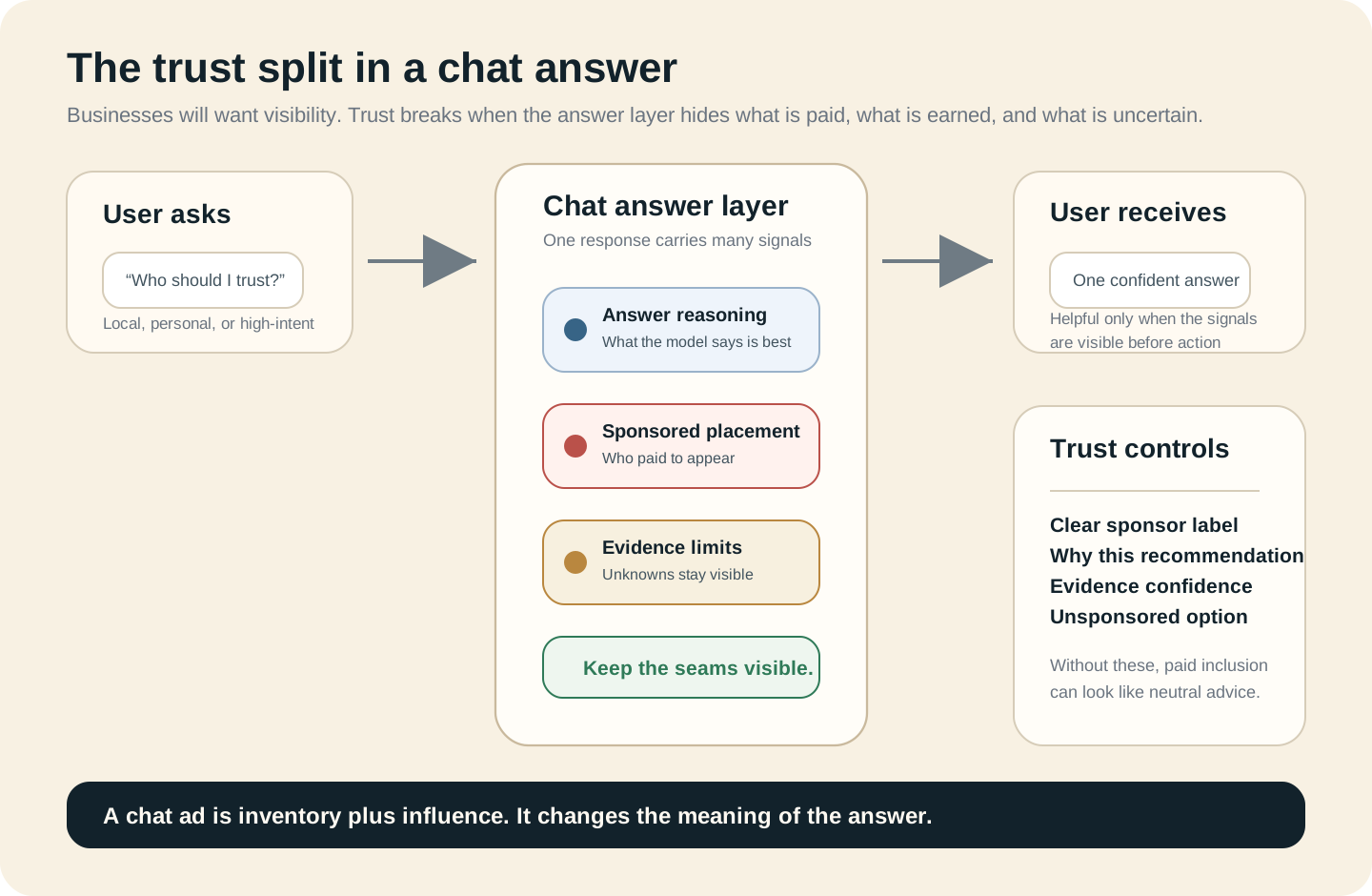
Search trust was messy, but it was user-controlled
Humans built their own trust workflow for traditional search over time: click one link, skim, bounce, compare, click again, and triangulate across competing sources.
In chat, that loop compresses. The model gives a synthesized answer with a confidence tone. That convenience is real, but it also concentrates influence in one response layer.
The paid representation problem is legitimate and unavoidable
Businesses will understandably want to be represented when users ask high-intent local questions. A local plumber, dentist, or restaurant owner does not want invisibility because a model failed to include them.
The hard question is how the system handles paid representation once it enters the answer layer. Users need to see a clean separation between:
- what is sponsored,
- what is trust-ranked from evidence,
- and what is uncertain because evidence is weak.
Why reviews alone are not a sufficient trust metric
A model deciding "best" based only on ratings or review count is fragile. Review ecosystems are noisy, gameable, and uneven across categories. In local decisions, stronger trust ranking usually needs a blended evidence stack.
I have written about this trust-degrade pattern before in a different context: legitimate gaming properties being wrapped in synthetic casino-review ecosystems after trust transfer events. See the AI disclosure gap is here for that callback.
- Service reliability signals: complaint patterns, response consistency, resolution behavior.
- Experience-fit signals: context match for the user question (budget, urgency, family needs, accessibility).
- Integrity signals: transparency history, disclosure behavior, and sentiment stability over time.
- Risk signals: safety flags, volatility spikes, and suspicious reputation jumps.
A practical trust-metrics framework for ads in chat
This is the kind of instrumentation I want around recommendation and monetization when the answer surface starts carrying paid placement:
The company-side version can carry the trust-model lineage later. For this RadiationBox piece, the important point is simpler: the ad layer needs to be measured as a trust event alongside the revenue model.
- Disclosure Recognition Rate: percent of users who can correctly identify sponsored placement.
- Credibility Delta: trust score difference between sponsored and unsponsored answer blocks.
- Recommendation Reversal Rate: how often users backtrack after independent verification.
- Regret Incidence: post-decision dissatisfaction linked to recommendation confidence mismatch.
- Cross-Source Verification Rate: how often users still seek second sources before acting.
- Vulnerable-Query Risk Index: harm exposure when ad adjacency appears near sensitive personal questions.
- Paid Inclusion Detectability: whether users understand why a business appeared in a list.
These metrics can help teams monitor whether monetization decisions are reducing user trust over time.
Design principles that could prevent a trust rupture
- Hard separation between answer reasoning and ad inventory.
- Plain-language sponsorship labels that users actually notice.
- Visible "why this recommendation" explanation including evidence limits.
- Category-level ad restrictions for sensitive personal queries.
- User controls to prefer unsponsored results when stakes are high.
Why this is a major trust inflection point
AI infrastructure spending is enormous. Revenue pressure is real. Ads in chat are likely to be a central business conversation. If short-term monetization weakens perceived answer integrity, platforms may see measurable erosion in long-term user trust.
I view ads in assistant interfaces as one of the next major trust inflection points of the internet. A careful version could make recommendations more transparent than legacy search ever was. A careless version could speed up synthetic trust decay at scale.
Where this sits in the RadiationBox thread
This sits beside the older RadiationBox pieces about synthetic media, disclosure, and trust transfer. Those pieces keep circling the same pressure point: people need to understand what they are looking at before they act on it.
If this thread is useful, read the AI disclosure gap is here next. The earlier wall-art era of AI piece is the softer version of the same problem: synthetic systems got easier to love before their trust signals got easier to read.